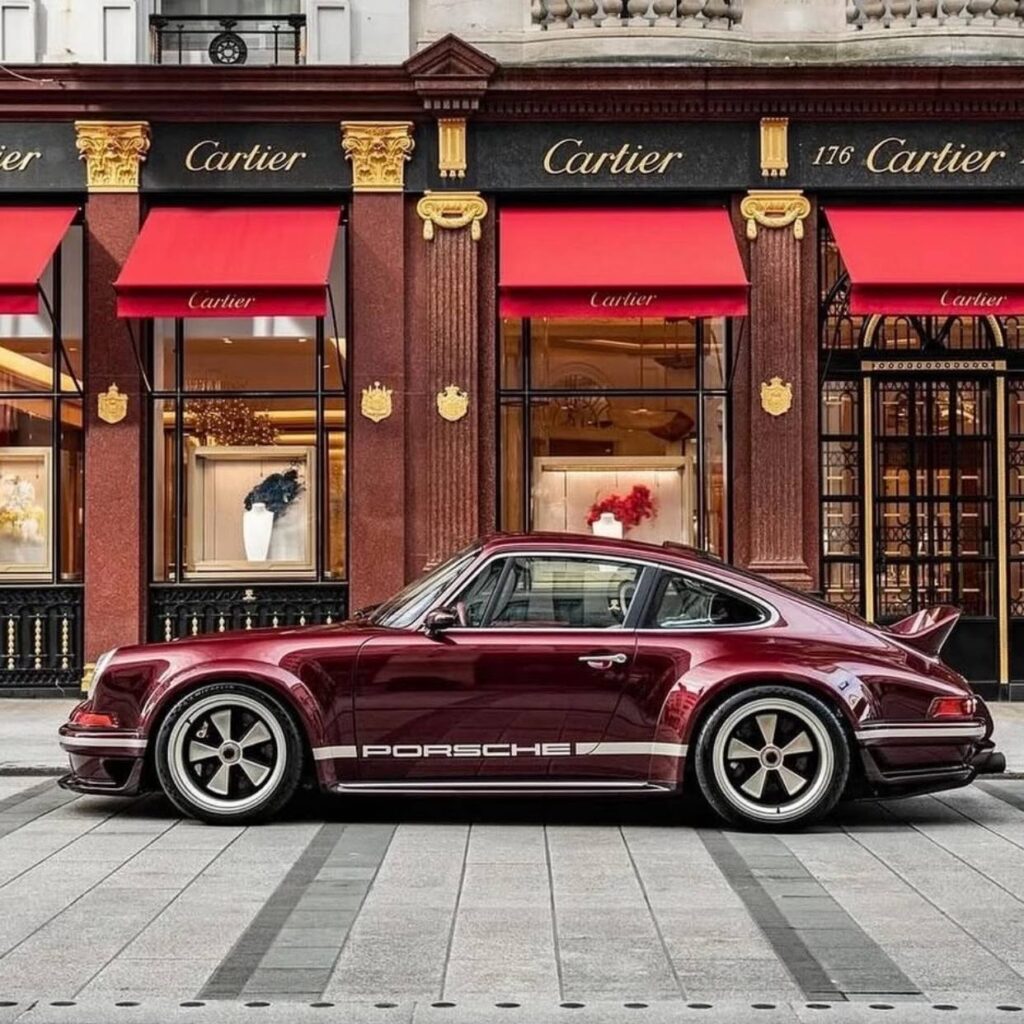
The Design: A Visual Masterpiece
The color on this specific commission appears to be a deep, lustrous burgundy or black-cherry metallic, accented by the signature “Porsche” side decal in silver or ghost-grey.
- The Silhouette: While it looks like a 1970s 911 S, the body is actually crafted almost entirely from carbon fiber. It features widened fenders that give it a “hunker-down” stance without losing the elegance of the original lines.
- The Details: Note the nickel-plated brightwork, the “sugar scoop” headlights (which house modern HID projectors), and the center-fill fuel cap on the hood—a nod to vintage race cars.
- The Wheels: Those are bespoke Fuchs-style forged aluminum wheels, wrapped in modern high-performance rubber to handle the massive increase in power.
Performance: The Soul of a Singer
Underneath that vintage skin is a modern mechanical beast. Most Singer Classic Studies are powered by a 4.0L naturally aspirated flat-six engine developed with Ed Pink Racing Engines (or Williams Advanced Engineering for the DLS models).
- Power: Typically producing around 390 to 400 horsepower. In a car that weighs significantly less than a modern Toyota Corolla, the power-to-weight ratio is staggering.
- The Sound: The “bark” of a Singer engine at its 8,000+ RPM redline is legendary—metallic, visceral, and unmistakably Porsche.
- The Drive: It uses a 6-speed manual transmission (usually a G50) and Ohlins suspension, making it feel telepathic on a winding road while remaining civilized enough to park in front of a luxury boutique.
The Verdict: Is it Worth the Hype?
With a price tag often exceeding $1,000,000 and a waiting list that spans years, a Singer is less of a car and more of a piece of functional art.
Pros: Flawless build quality, the ultimate “analog” driving experience, and timeless styling that will never look dated.
Cons: Prohibitively expensive and almost “too perfect” to drive hard on a rainy Tuesday.